
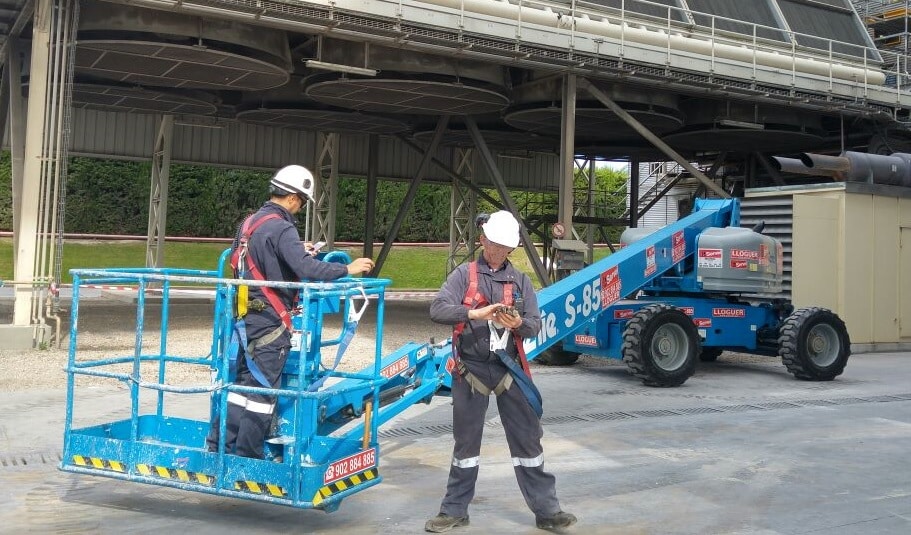
Safety recommendations for the installation and use of aerial work platforms (MEWPs).
Mobile Elevating Work Platforms (MEWPs) are work equipment designed, manufactured and intended to lift people safely. They are used to perform all types of work at height such as assembly, repairs, inspections, etc. both outdoors and indoors in the field of construction, rehabilitation of buildings and in any industry.
MEWPs have clear advantages over other equipment such as scaffolding, ladders, etc., such as being able to work from the platform itself, speed of installation, ease of use and transport, and the possibility of accessing difficult places. However, their risks should not be forgotten, such as platform overturning, falls to different levels, entrapment, impacts against elements, blows due to falling objects, etc.
Currently, there is no specific legislation regarding the conditions of installation, operation and maintenance of elevating platforms for people, but the following standard is available as reference UNE 58921 IN. “Instructions for the installation, operation, maintenance, revisions and inspections of mobile elevating platforms for personnel (PEMP)”.
Platforms are classified according to their lifting system, displacement, stabilization, feeding, etc.
- By its lifting system: telescopic boom, articulated boom, scissor platform, vertical mast.
- By its way of displacement: on tires, on caterpillar, on trailer. On truck.
- According to their power supply: electric, diesel.
The MEWP user is responsible for the correct operation of the MEWP. Therefore, he/she must be aware of the risks and situations that may cause harm to people.
- MEWP rollover
- Entrapment between moving parts of the structure or between the structure and the chassis
- Entrapment with roofs, structures or walkways
- Falling of the basket by catapult effect
- Fall of persons to a different level
- Fall of materials on people
- Contact of the MEWP with live components
For the safe operation of elevating platforms, the applicable legal and technical regulations must be known and complied with. (listed in NTP 1039)in addition to the instructions provided by the manufacturer and the rental company. On the other hand, basic instructions must be followed before using this equipment.
- Prior check of the work environment: the worker must have information about the work environment.
- Visual inspection of the MEWP: a simple and quick, but systematized visual inspection of the condition of the elevating platform, verification of the control systems and location of the emergency lowering controls should be carried out.
- Checking the proximity of power lines.
- Checking weather conditions, especially wind.
- Checking the retaining elements of the basket: To avoid the catapult effect, the basket must be fitted with retaining elements that prevent it from being thrown out.
- It is mandatory that the worker has appropriate PPE and that the platform is equipped with a safe anchorage point, if so stipulated by the manufacturer or the risk assessment.
- Checking the stability of the MEWP: it depends on the condition of the ground on which it rests, which must be sufficiently resistant so as not to deform under the weight of the whole (MEWP, people and materials) and have a slope below the limits indicated by the manufacturer.
A pre-operational test is recommended to verify the operation and safety of the MEWP.
Who can operate a platform lift?
They must be persons with the appropriate psychophysical and sensory aptitudes. In addition, they must be sufficiently trained to obtain the skills to operate this equipment.
Among the requirements to be met by the operator of a platform lift are the following:
- Be over 18 years of age.
- Physical and psychological aptitude for working at heights, in accordance with established protocols.
- Appropriate training: the standard UNE 58923 entitled “Mobile Elevating Work Platforms (MEWP).
- Have authorization for use issued by your company.
- If accessing public roads, you must also have a driving license that enables you to use the vehicle (for example, a truck-mounted MEWP).
With this post we want to contribute to the dissemination of the rules on training, safety and prevention of occupational hazards, must know every operator of elevating platforms. In the legal regulations section of this website, you will find the links to download the legal download the legal documentation and the different norms to which we have made reference previously and that will expand in detail the information you need to know.
At SERVEI we lift people and we like to do it safely.
Sources: EGARSAT – Pla e-Prevenga, 18/05/2016.